When AC Motor Repair Is the Right Next Step
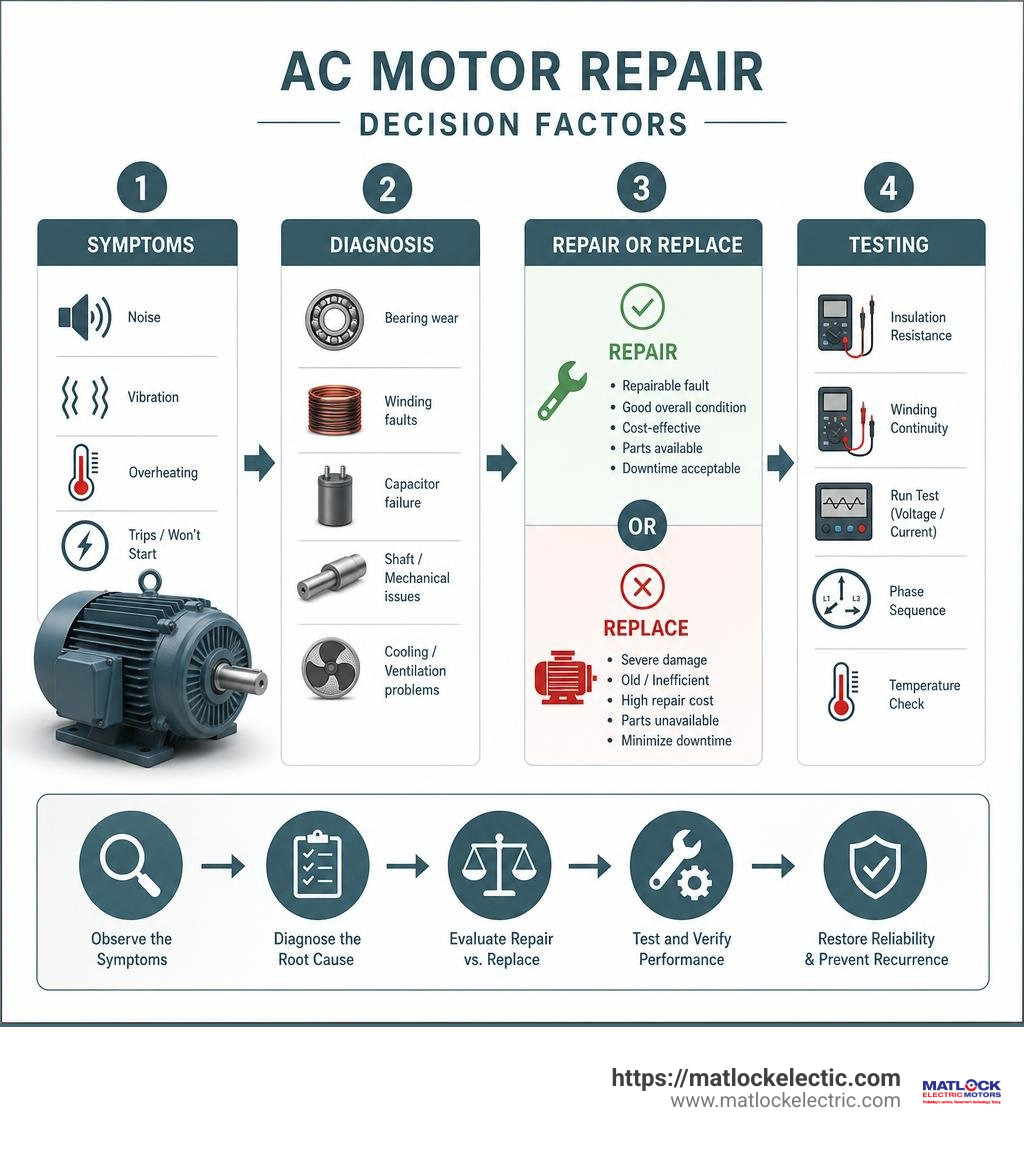
AC motor repair is often the best option when a motor has a clear, repairable fault such as a worn bearing, damaged winding, failed capacitor, or shaft issue. The right choice depends on the motor’s condition, repair cost, replacement availability, energy use, and the cost of downtime.
| Quick question | What it may mean |
|---|---|
| Is the motor noisy, vibrating, or running hot? | It may have a bearing, alignment, cooling, or balance problem. |
| Does it trip breakers, fail to start, or show low insulation resistance? | The winding, leads, controls, or power supply may be at fault. |
| Is the stator core sound and the motor otherwise in good condition? | A professional rebuild or rewind may be cost-effective. |
| Is the motor old, inefficient, severely damaged, or difficult to repair? | A new, higher-efficiency replacement may make more sense. |
Motor failures rarely happen at a convenient time. Across industrial facilities, the average motor failure rate is about 3.4% per unit each year. Bearings are the leading cause of failure, responsible for roughly 51% of cases, while stator winding faults account for about 16%.
A fast diagnosis matters, but a rushed decision can cost more. A quality assessment looks beyond the visible symptom to find the root cause, protect efficiency, and help prevent the same failure from returning.
Common Causes of AC Motor Failure and Field Diagnostics
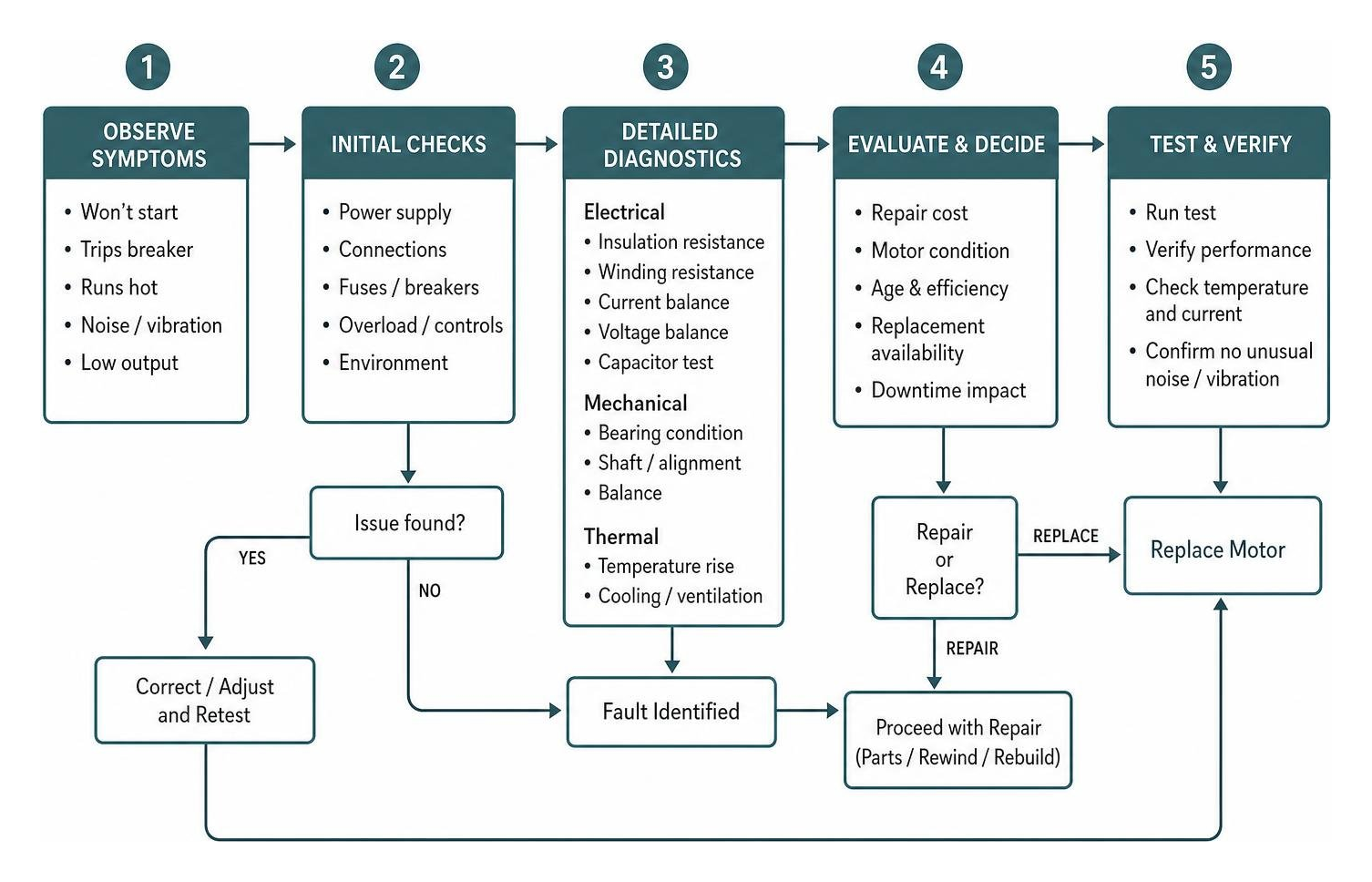
Understanding why alternating current motors fail is the first step toward effective troubleshooting. In industrial and commercial applications, operating stresses constantly act upon mechanical, electrical, and thermal boundaries. When these stresses exceed design limits, components breakdown.
Beyond mechanical wear, thermal degradation is a primary threat. Electrical insulation breaks down over time when exposed to excessive temperatures. In fact, a foundational rule of electric motor thermodynamics states that for every 10°C increase in winding temperature above its rated thermal limit, the thermal insulation life is cut by half. Thermal stress is often triggered by voltage unbalance, frequent line starting, ambient heat, or blocked cooling passages.
Electrical stress also takes a heavy toll. Transient voltage spikes, harmonic distortion from Variable Frequency Drives (VFDs), and phase imbalances damage magnet wire insulation. When evaluating complex industrial drive systems, utilizing modern Technology in Diagnostics allows field technicians to isolate subtle voltage unbalances and high-frequency wave harmonics before they break down stator insulation completely.
Identifying Bearing and Mechanical Faults
Because bearing failure accounts for 51.07% of all motor breakdowns, mechanical checks are our highest priority during preliminary field checks. Bearings support the heavy loads of rotating shafts, and when lubrication degrades or contamination enters the housing, failure rapidly follows.
Symptoms of mechanical fault include high-pitched squealing, low-frequency rumbling, elevated housing temperatures, and abnormal axial or radial vibration. Common causes include:
- Lubrication Breakdown: Over-greasing or under-greasing causes friction, leading to severe thermal breakdown and cage collapse.
- Shaft Misalignment: Misalignment between the motor shaft and driven load creates excessive load forces on end-bell bearings.
- Electrical Pitting: Fluting and pitting occur when shaft currents discharge through the bearing elements to the ground frame, common on ungrounded VFD applications.
- Fretting and Mechanical Wear: Loose bearing fits on the shaft journal or end-bell housing lead to fretting corrosion.
When mechanical degradation is detected early, performing specialized Mechanical Services—such as precision laser shaft alignment, journal sleeving, and custom housing machining—restores fit tolerances before catastrophic rotor-to-stator contact occurs.
Diagnosing Stator and Electrical Issues in AC Motor Repair
Stator winding breakdowns represent 15.76% of all motor failures. Electrical diagnostics must be systematic to avoid missing internal short circuits or ground faults.
Field diagnostics start with an insulation resistance test using a megohmmeter (megger) applied between phase windings and ground frame. Per IEEE Std 43 recommendations, an overhauled motor should yield a minimum insulation resistance of 20 megohms at a reference temperature of 40°C, though healthy modern windings often exceed hundreds of megohms.
We also measure DC phase resistance across all three winding pairs using a micro-ohmmeter. A resistance imbalance exceeding 3% between phases indicates turn-to-turn short circuits, open loops, or poor terminal connection points. Advanced field testing may include surge testing to detect weak inter-turn insulation before a total ground fault trips facility circuit breakers.
Evaluating Your Options: AC Motor Repair vs. Replacement
When an industrial motor stops, plant managers face an immediate fork in the road: should we repair the existing motor or purchase a brand-new unit?
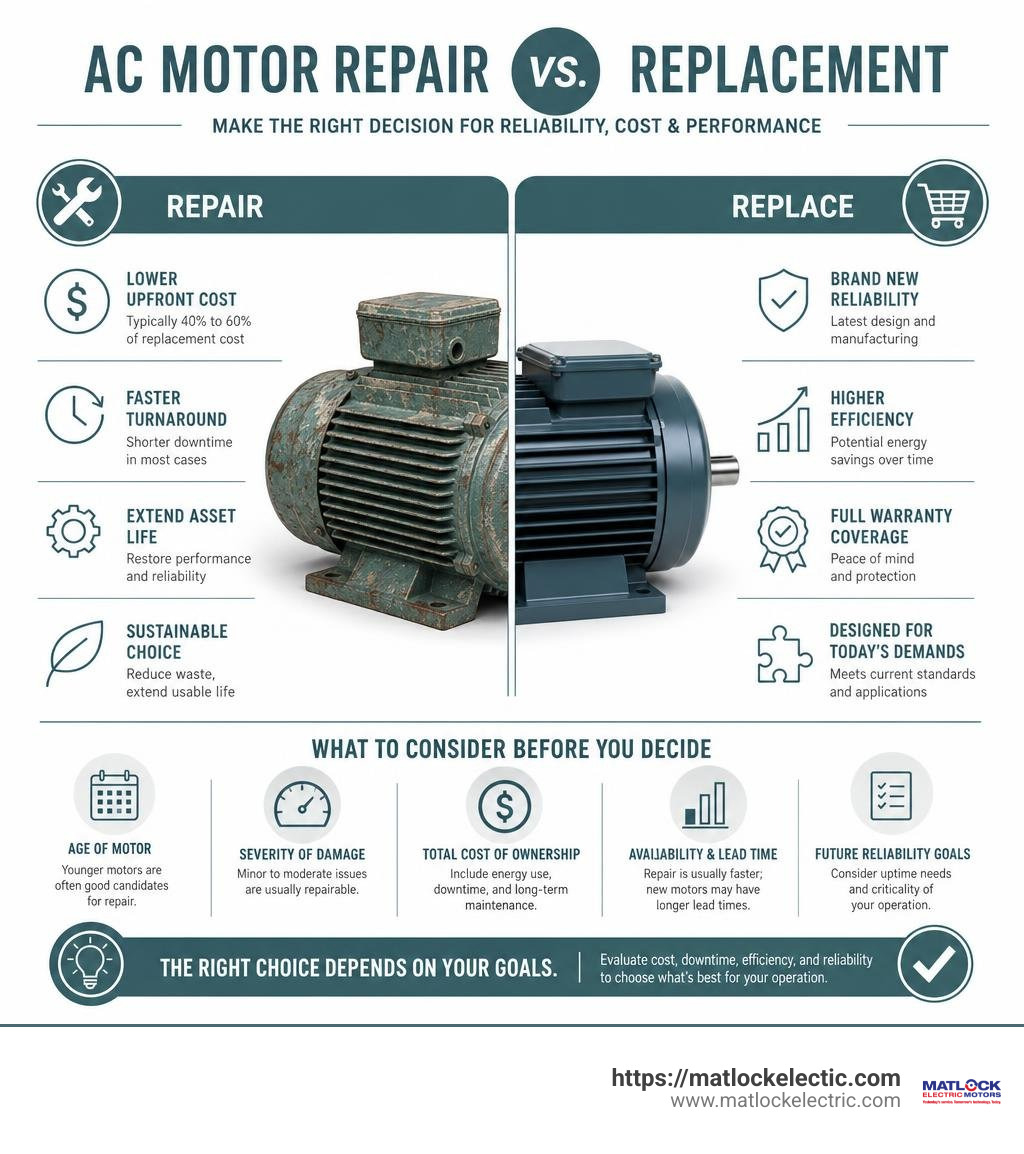
Deciding between ac motor repair and replacement requires balancing upfront turnaround costs, long-term energy consumption, downtime expenses, and equipment age.
| Evaluation Factor | AC Motor Repair | Full Motor Replacement |
|---|---|---|
| Upfront Cost | Typically 40% to 60% of replacement cost | Full new equipment purchase price |
| Lead Time | Often faster for specialized or large frames | Subject to factory lead times (weeks/months) |
| Custom Mounting | Preserves original shaft, footprint, and conduits | May require mechanical modifications or adaptors |
| Efficiency Impact | Preserved or improved with Class H insulation | Guaranteed NEMA Premium efficiency rating |
| Warranty | Covers reconditioned/rewound components | Full factory OEM warranty |
Evaluating Differences of AC DC Motors reveals that large multi-phase induction motors often feature cast-iron frames, heavy copper density, and custom mounting flanges that make physical replacement far more expensive and labor-intensive than a precision shop rebuild. Conversely, fractional-horsepower standard frame motors are almost always cheaper to replace. If immediate replacement is required, exploring specialized Electric Motor Sales provides access to new energy-efficient inventory tailored to your facility’s mounting requirements.
Economic and Payback Analysis
Energy costs dominate the total lifecycle cost of an electric motor. Over a typical 10-to-15-year operational lifespan, electricity costs can represent up to 95% of the motor’s total cost of ownership, far outweighing the initial purchase price.
Consider the cost of minor efficiency losses:
- A 1% drop in efficiency on a 100 hp motor running 3,000 hours per year at $0.05/kWh adds approximately $111 to your annual power bill.
- The same 1% drop in efficiency on a 100 hp motor running 8,000 hours per year at $0.09/kWh adds $528 annually.
When choosing between repairing an existing standard motor or upgrading to a new NEMA Premium model, calculate the simple payback period:
$$text{Payback Period (Years)} = frac{text{Cost of New Motor} – text{Cost of Repair}}{text{Annual Electricity Savings}}$$
If a continuous-duty motor operates over 6,000 hours annually, energy savings from an efficiency upgrade might offset the price differential within 12 to 18 months. However, if replacement hardware has a 16-week delivery lead time, the cost of facility downtime ($5,000 to $50,000+ per hour) makes rapid professional repair the clear economic winner.
Evaluating Core Loss and Rewind Feasibility
A motor is only as good as its stator core. The stator core consists of thousands of thin steel laminations coated with electrical insulation to suppress eddy currents. If overheating or mechanical rotor rubbing damages these laminations, core losses spike, converting electrical energy into unwanted heat.
Before approving a complete winding rewind, service centers perform a core loss test (loop test). By applying electromagnetic magnetic flux (typically 85,000 lines per square inch rms), technicians measure heat dissipation in watts per pound. If post-burnout core loss increases by more than 10% compared to pre-burnout values, or if localized hot spots rise more than 15°C above average core temperatures, core iron repair or replacement is mandatory.
When core integrity is verified, rewinding with modern Class F (155°C) or Class H (180°C) thermal insulation systems often upgrades the motor beyond its original factory specifications, extending thermal life while preserving core efficiency.
Key Steps in the Professional AC Motor Repair Process

A comprehensive shop restoration follows rigid standards to ensure structural, mechanical, and electrical performance. When a unit enters a specialized center for comprehensive AC Repairs, every step must be logged, photographed, and verified.
Complete Inspection and Diagnostic Testing
The intake process begins long before dismantling components:
- Visual and Mechanical Intake: Technicians document nameplate data, check terminal box integrity, verify mounting foot flatness (within 0.005 inches), check rotation tags, and take initial intake photos.
- Preliminary Electrical Checks: Megohmmeter tests at 500V or 1000V DC establish baseline insulation resistance. Winding resistance balance across phases is measured to pinpoint shorted turns.
- Dimensional Fit Inspections: Using micrometers, bore gauges, and Coordinate Measuring Machines (CMM), technicians measure shaft extension runout, bearing journal diameters, end-bell housing bores, and seal surface clearances.
- Polarization Index (PI) Testing: A 10-minute DC insulation test compares 10-minute resistance to 1-minute resistance ($PI = R_{10min} / R_{1min}$). A PI ratio above 2.0 confirms clean, dry insulation suitable for further testing.
Stator Rewinding and In-House Machining
If diagnostics reveal shorted or grounded coils, full stator restoration is performed following technical guidelines outlined in the Model Repair Specifications for Low Voltage Induction Motors.
The stator is placed in a temperature-controlled pyrolysis burnout oven. Burnout temperatures are capped strictly at 360°C to 370°C (680°F–700°F) for organic insulation to burn off old varnish without damaging interlaminar core insulation. Hand-held torches or open flames are strictly prohibited as they cause localized warping of core iron.
New coils are precision-wound using inverter-duty, corona-resistant magnet wire. Phase insulation barriers and slot liners made of high-temperature NOMEX or Mylar are inserted. The re-wound stator undergoes Vacuum Pressure Impregnation (VPI) or dip-and-bake cycles using Class H epoxy resins, cured in baking ovens under 270°F (132°C).
In-house machine shops simultaneously restore damaged mechanical parts:
- Worn bearing journals are restored through thermal metal spray deposition or precision sleeving rather than unapproved short-term fixes like knurling or peening.
- Damaged keyways, bent shafts, and worn end-bell housings are turned on lathes to meet ISO 286-2 fit tolerances (typically J6 or K6 fits).
Dynamic Balancing and Mechanical Assembly
Once electrical components are prepared, assembly requires precise dynamic balancing:
- Rotor Balancing: Rotating parts are dynamically balanced on two planes to meet ISO 1940-1 Grade G1.0 standards. Achieving G1.0 balance dramatically reduces operational vibration compared to standard OEM factory balance levels (typically G6.3), protecting bearing races from fatigue.
- Bearing Replacement: Old anti-friction bearings are discarded. New C3-clearance bearings are heated evenly using induction heaters (capped at 110°C / 230°F) to allow smoothly sliding onto shaft journals without force.
- Sealing and Reassembly: End bells, seals, and terminal boxes are refitted. Drive-end roller bearings are properly pre-loaded to prevent skidding wear during initial startup.
Selecting a Qualified Service Center for AC Motor Repair
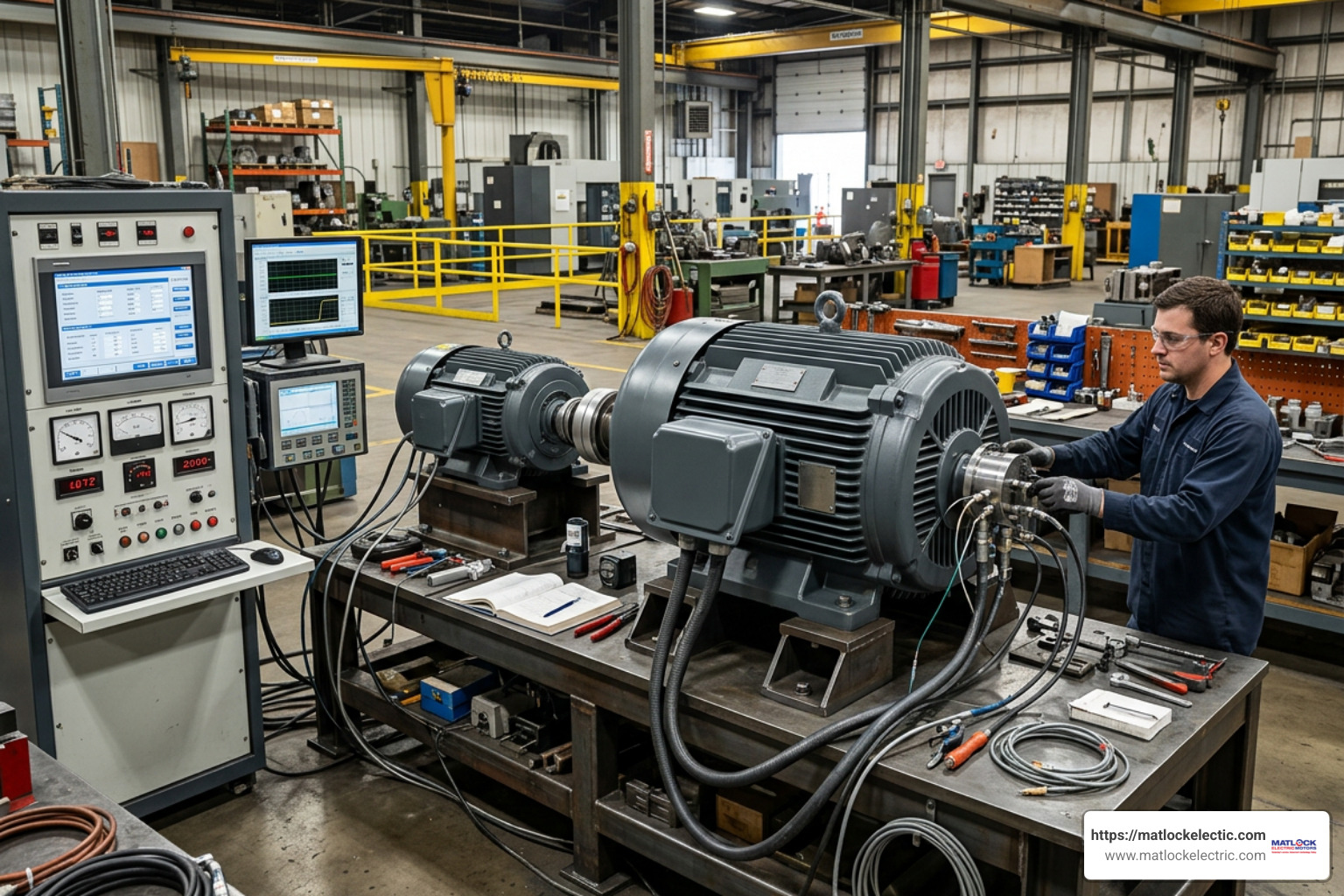
Choosing the right service partner is critical to obtaining a reliable repair that preserves motor efficiency. Entrusting high-value industrial equipment to a facility without proper equipment leads to premature re-failure.
Facilities seeking expert service can count on complete shop capabilities through dedicated Repair programs designed for demanding industrial machinery.
Key Qualification Metrics and Technical Standards
When auditing an electric motor repair facility, verify the following standards and capabilities:
- EASA Accreditation: Ensure the shop adheres to Electrical Apparatus Service Association (EASA) AR100 standards for electrical repair and rewinding.
- Calibrated Testing Equipment: Confirm access to core loss testers, surge comparison analyzers, dynamic balancing rigs, and micro-ohmmeters.
- Controlled Thermal Equipment: Verify the shop utilizes chart-recorded pyrolysis burnout ovens with strict temperature controls.
- Detailed Service Reports: Reputable centers issue written multi-page diagnostic reports including pre- and post-repair electrical data, dimensional micrometer logs, balance reports, and 1-hour run-test documentation.
- Warranty Support: Look for comprehensive warranty coverage (such as a 12-to-36-month in-service guarantee) backing both labor and replacement materials.
Post-Repair Testing Procedures in AC Motor Repair
Before an AC motor leaves the shop, it undergoes a battery of quality verification tests outlined in standard AC Repair Specifications Guidelines.
The finalized motor undergoes a minimum 1-hour no-load run test at full nameplate voltage. During this run, technicians record:
- Current Balance: Line currents across all phases must match within 3%.
- Vibration Spectrum Analysis: Fast Fourier Transform (FFT) vibration analysis measures velocity (in/sec RMS) to verify smooth mechanical operation.
- Thermal Imaging: Infrared thermography screens for localized bearing hotspots, loose connections, or winding phase thermal imbalances.
- High-Potential (Hi-Pot) & Surge Testing: Final overpotential voltage testing verifies ground insulation integrity under peak stress.
For complete technical specifications across regional repair networks, industrial clients often reference comprehensive technical guidelines and standardized specifications when overseeing complex 3-phase electric motor refurbishments.
Preventive Maintenance to Extend AC Motor Lifespan
Repairing a failed motor restores operation, but a proactive preventive maintenance program stops breakdowns before they occur. Regular inspection routines protect your capital investments and eliminate unexpected production outages.
Complex plant automation systems—including high-precision motion controls—also require dedicated attention; integrating specialized Servo Motor Repair schedules alongside main line AC drives ensures facility-wide uptime.
Continuous Condition Monitoring
Modern maintenance relies on predictive diagnostic technologies:
- Vibration Monitoring: Permanent or handheld vibration sensors track overall amplitude and velocity spikes, detecting bearing fluting or rotor imbalance weeks before mechanical failure occurs.
- Thermal Tracking: Periodic infrared inspections identify blocked ventilation ports, high ambient thermal stress, or failing electrical terminations.
- Electrical Signature Analysis (ESA): Monitoring current harmonics reveals broken rotor bars, air gap eccentricities, and power supply distortions while the motor operates under normal load.
Cleanliness and Environmental Protection
Environmental contamination shortens motor life rapidly:
- Dust and Debris Accumulation: Dust layers acting as thermal insulation restrict frame cooling fins, raising internal temperatures. Clean cooling passages regularly.
- Moisture and Corrosion Control: In humid environments, space heaters prevent condensation from degrading winding insulation during offline cycles.
- Seal Integrity: Inspect shaft lip seals and labyrinth seals regularly to prevent process fluids, abrasive dusts, or cutting fluids from entering bearing cavities.
Frequently Asked Questions About AC Motor Repair
Does rewinding an AC motor reduce its operating efficiency?
Not when performed correctly. Extensive joint research by EASA and the AEMT proved that when proper rewinding practices are maintained—specifically keeping burnout oven temperatures under 370°C (700°F)—there is zero loss of core efficiency. In fact, replacing old Class B insulation with high-performance Class H magnet wire and applying VPI resin can occasionally increase thermal heat dissipation, making the rewound motor slightly more efficient than its original factory design.
How long does a standard industrial AC motor repair take?
Standard shop overhaul and bearing replacement typically takes 2 to 4 business days. Full stator rewinding typically requires 5 to 7 business days to complete stripping, coil winding, VPI baking, mechanical machining, dynamic balancing, and testing. Most certified service shops offer 24/7 emergency rush services to complete critical repairs within 24 to 48 hours when facility downtime costs are severe.
What documentation and warranty should I expect after repair?
A professional repair facility provides a complete service documentation package containing:
- Pre-repair intake inspection logs and failure root-cause analysis.
- Dimensional measurement sheets for shaft journals, housing bores, and runout tolerances.
- Pre- and post-burnout core loss test results.
- Dynamic balancing certification graphs complying with ISO 1940-1.
- No-load run-test performance records (vibration spectrum, current balance, thermal baseline).
- A written 12-to-36-month warranty covering materials and shop craftsmanship.
Conclusion
A failing AC motor does not have to result in catastrophic production loss or exorbitant replacement expense. By systematically identifying common failure causes—from bearing wear to stator winding breakdown—and applying structured economic decision matrixes, plant managers can make confident repair decisions.
Whether you need mechanical shaft restoration, precision dynamic balancing, or complete stator rewinding, partnering with a certified shop ensures your equipment performs to original OEM standards. For broader industrial support across all electromechanical systems, exploring full-service repair capabilities like DC Repairs ensures every drive system across your facility operates at peak reliability.
When you need rapid response, diagnostic accuracy, and certified craftsmanship, trust our team at Matlock Electric to bring your vital electric motor assets back to life efficiently and reliably.